






Climate Change Symposium
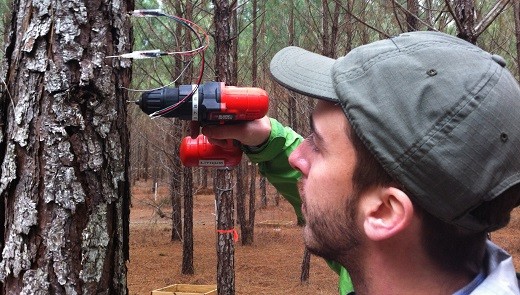
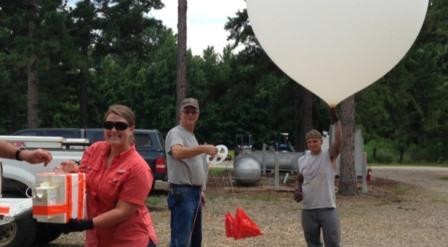
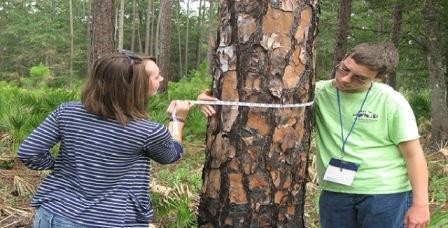
 This one-day professional development opportunity for middle and high school science teachers was held on May 24, 2013 at University of Florida in Gainesville, Florida. This symposium included faculty research presentations and discussions related to climate change, and engaged educators in novel hands-on activities they can use to teach climate change related topics in the classroom. Florida-specific projections and implications of climate change were used to consider potential risks to coastal development, ecosystems, and forest health.
Symposium Materials: Presentations and Handouts
What We Know about Teaching Students about Climate Change
Martha Monroe, Professor, School of Forest Resources and Conservation
Climate Change and Its Impacts on Marine Organisms and Ecosystems
Don Behringer, Assistant Professor, Fisheries and Aquatic Sciences Program, School of Forest Resources and Conservation
Coral Reefs and Climate
Chelsea Crandall, Research Assistant, School of Natural Resources and Environment\
Resources:
Cobb, K.M. et al. 2013. Highly Variable El Niño-Southern Oscillation Throughout the Holocene. Science 339:67-70.
Activities on sea surface temperature changes and coral reef acidification:
http://coralreef.noaa.gov/education/oa/
http://www.dataintheclassroom.org/content/oa/get-data.html
http://coralreef.noaa.gov/education/educators/resourcecd/activities/resources/bleaching_sa.pdf
http://coralreef.noaa.gov/education/educators/resourcecd/activities/
Climate and Agriculture: Variability, Change, and What Can Be Done To Be Prepared
Daniel Dourte, Research and Extension Assistant, Department of Agricultural and Biological Engineering
Leveraging Easily Accessible Web-Gased Geospatial Tools and Datasets to Teach Climate Change (and Other Subjects!)
Bob Swett, Associate Professor, School of Forest Resources and Conservation
Handouts:
Using ArcGIS Online for Instruction
Mapping with ArcGIS Online
Advancing STEM Education with GIS
Instructional Use of GIS
Why So Many Perceptions about Climate?
Martha Monroe, Professor, School of Forest Resources and Conservation
* The handouts used in this session can be found in Activity 2: Clearing the Air (pages 26-44) of the PLT Module Draft.
Potential Effects of Sea Level Rise on Florida's Coastal Ecosystems
Whitney Gray, Sea Level Rise Coordinator, Florida Fish and Wildlife Conservation Commission
Adaptation to Climate in Southern Pines
Gary Peter, Professor, School of Forest Resources and Conservation
Jianxing Zhang, Graduate Assistant, School of Forest Resources and Conservation
*The handouts used in this session can be found in Activity 5: Mapping Seed Sources (pages 74-82) of the PLT Module Draft.
Climate Models and Ecosystems on the Move
Tim Martin, Professor, School of Forest Resources and Conservation
*The handouts used in this session can be found in Activity 3: Atlas of Change (pages 45-59) of the PLT Module Draft.
Carbon: Cycling, Sequestration, and Measuring It In Trees
Maxwell Wightman, Research Assistant, School of Forest Resources and Conservation
*The handouts used in this session can be found in Activity 6: Carbon on the Move (pages 85-97) and Activity 7: Counting Carbon (pages 98-115) of the PLT Module Draft.
Forest Health and Climate Change
Jeffrey Eickwort, Biologist and Supervisor, Florida Forest Service, Forest Health Section
Florida's Dynamic Forests: Building a Forest System Model
Chris Demers, Extension Associate, School of Forest Resources and Conservation
*The handouts used in this session can be found in Activity 4: Managing Forests for Change (pages 62-73) of the PLT Module Draft.
Forest Carbon and Products over Time
Tim Martin, Professor, School of Forest Resources and Conservation
*The handouts used in this session can be found in Activity 11: The Carbon Puzzle (pages 143-151) of the PLT Module Draft.
Sea Level Rise and Coastal Community Planning
Kathryn Frank, Assistant Professor, Department of Urban and Regional Planning
Handouts:
Sea Level Rise Adaptation Strategy Role-Play Game
Planning for Coastal Change Curriculum Cedar Key Summer Youth Program
Climate Change and Forests
Tim Martin, Professor, School of Forest Resources and Conservation
Additional Resources
- Climate Change Evidence, Impacts, and Choices: Answers to common questions about the science of climate change (National Research Council, 2012).
- Resources for supporting data for climate change:
- The Intergovernmental Panel on Climate Change (IPCC): http://www.ipcc.ch/. You can download reports, news releases, and all sorts of graphs and figures. For U.S. specific data, go to http://www.ipcc.ch/publications_and_data/publications_and_data_reports.shtml.
- The National Oceanic and Atmospheric Administration (NOAA) is the federal resource for climate data. http://www.noaa.gov/climate.html. NOAA also has a new site: http://www.climate.gov.
- The National Academy of Sciences has a Climate Change Research web site: http://nas-sites.org/americasclimatechoices/.
- The National Environmental Sattelite, Data, and Information Service (NEDIS) technical report on climate trends and projections is recommended for regional information on the Southeast:
http://www.nesdis.noaa.gov/technical_reports/NOAA_NESDIS_Tech_Report_142-2-Climate_of_the_Southeast_U.S.pdf. - The National Climate Assessment and Development Advisory Committee (NCADAC) recently released a draft climate assessment report for public review: http://www.ncadac.globalchange.gov/.
- The Climate Literacy Network maintains the Climate Literacy and Energy Awareness Network with hundreds of activity ideas sorted by grade, topic, and objective: http://cleanet.org/index.html.
- Every county has an office that is directly connected to the University of Florida through IFAS/Extension. You can find your office at http://solutionsforyourlife.com . That site also has an electronic document system (http://edis.ifas.ufl.edu) with hundreds of fact sheets related to Florida. It is a great resources that can answer a zillion questions!
- Some symposium sessions used activities from a new Project Learning Tree Secondary Module, Climate Change and Southeastern Forests that has been developed in partnership with PINEMAP. A draft version of the module is available at the link below (please note that this version will be updated later in the summer with feedback from a subject matter expert review).
PLT Module DRAFT, February 2013
Thanks to the Symposium Sponsors!
- PINEMAP: www.pinemap.org
- Florida Climate Institute: http://floridaclimateinstitute.org
- UF Center for Precollegiate Education and Training (CPET): http://www.cpet.ufl.edu
- UF School of Forest Resources and Conservation: www.sfrc.ufl.edu
- League of Environmental Educators in Florida (LEEF): http://leef-florida.org


